


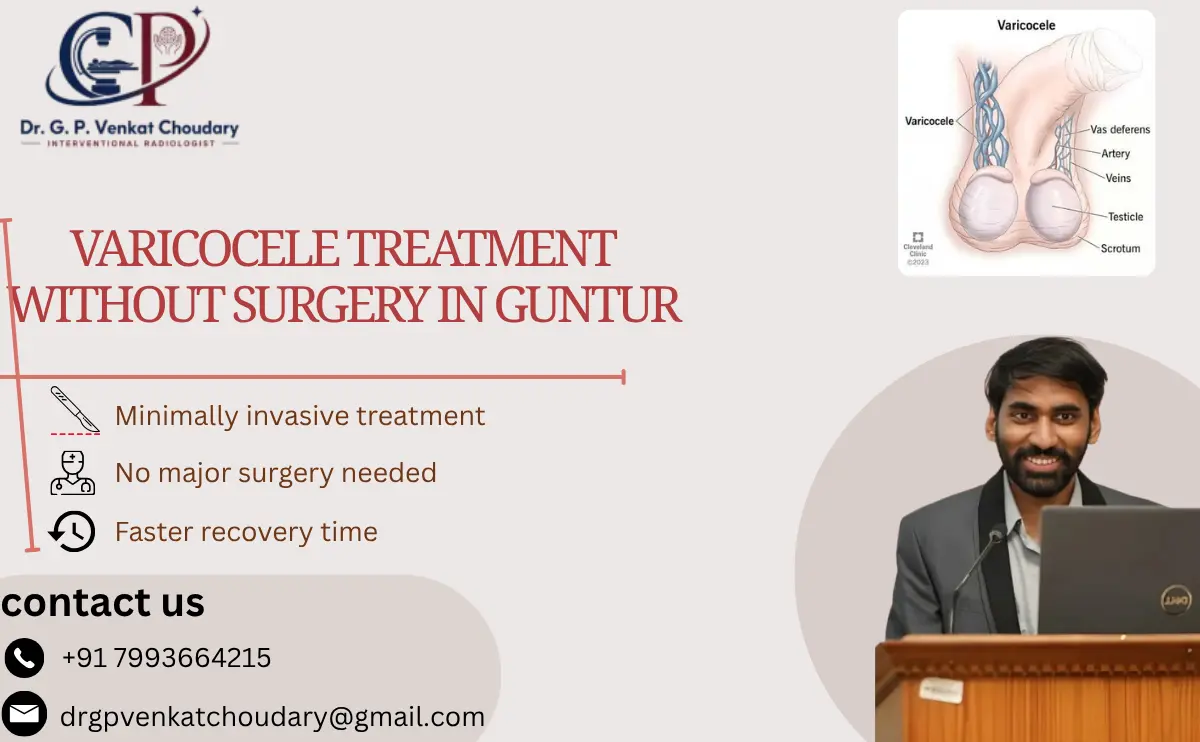
Varicocele is an enlargement of the veins around the testicle, usually caused by abnormal blood flow through the veins. It can occur without symptoms, but some men experience scrotal heaviness, aching, swelling, or fertility-related concerns. The good news is that selected patients may be treated with minimally invasive approaches rather than conventional open surgery.
Varicocele Treatment Without Surgery in Guntur may include image-guided Varicocele Embolization Treatment, a procedure performed by an interventional radiologist. The appropriate treatment depends on the severity of the varicocele, symptoms, fertility concerns, examination findings, and imaging results.
For patients searching for Varicocele Treatment in Guntur, understanding the available options can help them discuss an appropriate treatment plan with a qualified specialist.
What Is Varicocele and What Causes It?
Understanding Varicocele
A varicocele is similar to varicose veins but occurs in the veins of the scrotum. It most commonly develops on the left side because of differences in venous anatomy. Some varicoceles are discovered during a physical examination, while others are identified during an evaluation for male infertility.
A varicocele does not always require treatment. Treatment is generally considered when symptoms, testicular changes, fertility concerns, or other clinically relevant findings are present.
Common Symptoms of Varicocele
Some men have no noticeable symptoms. When symptoms occur, they may include:
- Dull or aching pain in the scrotum
- A feeling of heaviness or discomfort
- Swelling or enlarged veins around the testicle
- Discomfort that becomes more noticeable after standing or physical activity
- Symptoms that improve when lying down
- Fertility difficulties in some patients
- Changes in testicular size in certain cases
Persistent or worsening symptoms should be medically evaluated rather than self-diagnosed.
Why Does Varicocele Develop?
The veins surrounding the testicle contain valves that help direct blood toward the heart. If these valves do not function properly, blood can flow backward and collect within the veins. This can cause the veins to become enlarged.
Factors involved may include venous anatomy and impaired blood flow. A varicocele is not necessarily caused by physical activity, sexual activity, or a particular lifestyle habit.
How Is Varicocele Diagnosed and Treated Without Surgery?
Diagnosis of Varicocele
Diagnosis usually begins with a medical history and physical examination. The doctor may examine the scrotum while the patient is standing and may ask the patient to perform a Valsalva maneuver, which can make enlarged veins easier to detect.
When further assessment is needed, scrotal Doppler ultrasound can evaluate blood flow and help identify reflux in the affected veins. It may also provide information about testicular size and other findings.
For men being evaluated for fertility concerns, semen analysis may also be recommended. Additional investigations depend on the patient’s symptoms and clinical situation.
What Is Varicocele Embolization?
Varicocele Embolization Treatment is a minimally invasive procedure used to block the abnormal veins responsible for the varicocele. Instead of making a surgical incision in the scrotum, an interventional radiologist accesses the venous system through a small catheter.
During the procedure, imaging guidance is used to identify the abnormal veins. An embolic material is then placed to redirect blood flow through healthier veins.
How Is the Procedure Performed?
The procedure generally involves these steps:
- The patient undergoes an assessment before treatment.
- Local anesthesia is used at the access site, depending on the planned approach.
- A small catheter is introduced into a vein.
- Imaging guidance helps the interventional radiologist identify the abnormal veins.
- The affected veins are treated using appropriate embolic material.
- Blood is redirected through alternative healthy veins.
- The catheter is removed and the access site is monitored.
The exact technique and embolic material used can vary according to the patient’s anatomy and the treating specialist’s assessment.
Who May Be Considered for Non-Surgical Treatment?
Not every varicocele requires intervention, and embolization is not appropriate for every patient. It may be considered in selected patients with clinically significant varicocele, persistent symptoms, fertility-related concerns, or recurrence after previous treatment.
A detailed evaluation is important before deciding whether Varicocele Treatment Without Surgery in Guntur is appropriate.
Benefits, Recovery and Comparison With Surgery
Potential Benefits of Varicocele Embolization
For appropriately selected patients, minimally invasive embolization may offer several potential advantages:
- No surgical incision in the scrotum
- Image-guided treatment
- Small access site
- Generally shorter recovery than conventional surgery
- Ability to treat recurrent varicocele in selected cases
- Can be performed through a catheter-based approach
The expected outcome varies between patients. Embolization should not be presented as a guaranteed solution for infertility or pain.
Recovery After Treatment
Recovery depends on the procedure, access route, overall health, and individual circumstances. Many patients can return to routine activities relatively quickly, although strenuous exercise and heavy lifting may need to be avoided for a period recommended by the treating doctor.
Some temporary soreness or discomfort around the access site may occur. Follow-up allows the doctor to assess recovery and determine whether further evaluation is required.
Patients should follow their individual post-procedure instructions and report significant pain, swelling, fever, bleeding, or other concerning symptoms promptly.
Varicocele Embolization vs Surgical Treatment
Both embolization and surgical varicocele repair aim to stop abnormal blood flow through the affected veins. However, they use different approaches.
| Feature | Varicocele Embolization | Surgical Repair |
| Approach | Catheter-based | Surgical procedure |
| Scrotal incision | Generally not required | May be required depending on technique |
| Imaging | Performed under image guidance | Uses surgical visualization |
| Recovery | Often relatively quick | Depends on surgical technique |
| Suitable for recurrence | May be considered in selected cases | May also be considered |
| Decision | Depends on individual anatomy and condition | Depends on individual anatomy and condition |
There is no single treatment that is right for every patient. The choice should be based on clinical findings, imaging, fertility goals, symptoms, previous treatment, and specialist assessment.
For patients looking for Varicocele Treatment Without Surgery in Guntur, consultation with an experienced interventional radiologist can help determine whether embolization is a suitable option.
What Factors Determine Treatment?
Treatment planning may consider:
- Severity and grade of varicocele
- Pain or other symptoms
- Testicular size and development
- Semen analysis and fertility concerns
- Doppler ultrasound findings
- Previous varicocele treatment
- Overall medical history
- Venous anatomy
- Individual treatment goals
This is why treatment should not be selected solely on the basis of an online search. A personalized assessment is essential.
Frequently Asked Questions About Varicocele Treatment Without Surgery in Guntur
1. Can varicocele be treated without surgery?
Yes. Selected patients may be treated with minimally invasive Varicocele Embolization Treatment, which uses a catheter to block abnormal veins rather than performing conventional surgical repair.
2. Is varicocele embolization painful?
The procedure is generally performed with local anesthesia and appropriate pain control. Some patients may experience temporary discomfort or soreness afterward.
3. Does varicocele always require treatment?
No. Small or asymptomatic varicoceles may not require intervention. Treatment decisions depend on symptoms, fertility concerns, testicular findings, and clinical assessment.
4. Can varicocele treatment improve fertility?
Varicocele treatment may improve semen parameters in some appropriately selected patients, but fertility outcomes vary. A fertility evaluation and semen analysis may be recommended before treatment.
5. How long does recovery take after embolization?
Recovery varies by patient and procedure. Many patients can resume routine activities relatively soon, while strenuous activities may need to be restricted temporarily according to medical advice.
6. Is embolization an alternative to surgical varicocele repair?
For selected patients, yes. Embolization and surgery use different techniques to treat abnormal venous blood flow. The appropriate option depends on individual clinical and anatomical factors.
7. Can a varicocele return after treatment?
Recurrence or persistence can occur after treatment. The likelihood depends on factors such as the treatment technique, venous anatomy, and individual circumstances. Follow-up is important when symptoms persist or return.
8. When should I see a specialist for varicocele?
Consult a specialist if you have persistent scrotal pain, swelling, a noticeable mass of veins, testicular size changes, or fertility concerns. Prompt evaluation can help identify the cause and available treatment options.
9. Is varicocele embolization available in Guntur?
Patients in Guntur can consult an interventional radiologist to determine whether catheter-based embolization is available and clinically appropriate for their condition.
10. Does every patient need the same varicocele treatment?
No. Varicocele Treatment depends on the patient’s individual condition, symptoms, imaging findings, fertility goals, medical history, and previous treatment. A personalized evaluation is necessary.
Conclusion
Varicocele Treatment Without Surgery in Guntur can be an option for selected patients who may benefit from a minimally invasive, image-guided approach. Varicocele Embolization Treatment works by blocking abnormal veins and redirecting blood through healthier venous pathways.
However, treatment is not automatically required for every varicocele, and embolization may not be suitable for every patient. A proper examination, Doppler ultrasound when indicated, and consideration of fertility and symptom-related factors are important before choosing a treatment approach.
Book an Appointment With Dr. G.P. Venkat Choudary
If you are experiencing symptoms of varicocele or have fertility-related concerns, consult Dr. G.P. Venkat Choudary, Neuro and Vascular Interventional Radiologist, for an individualized evaluation and discussion of suitable treatment options.
Location: KIMS-SIKHARA Hospitals, Mangalagiri Road, near Best Price, Agatha Varappadu, Guntur, Andhra Pradesh 522001
Phone: 079936 64215
Email: drgpvenkatchoudary@gmail.com