


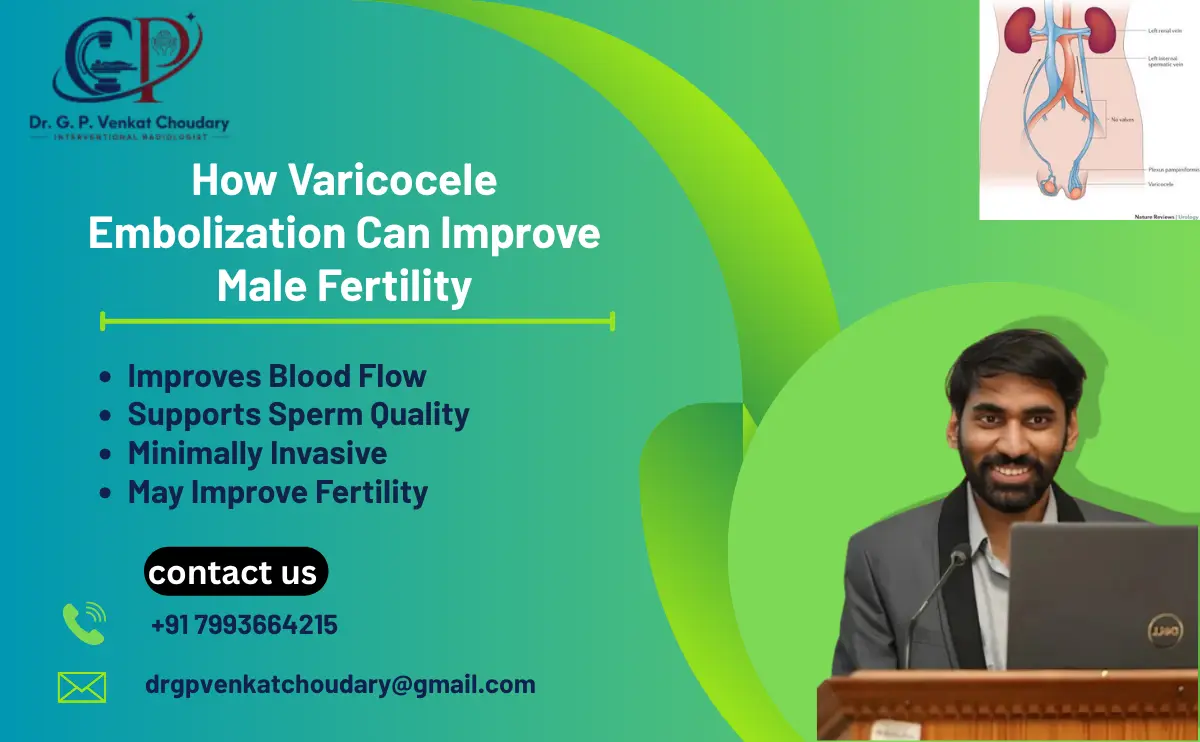
Male fertility can be affected by several factors, including sperm production, hormone levels, reproductive health, and blood flow around the testicles. One potentially treatable condition is a varicocele, which refers to enlarged veins within the scrotum. It can affect one or both sides and is sometimes associated with abnormal semen parameters, testicular discomfort, or reduced testicular size.
Varicocele does not automatically mean infertility. Many men with this condition can father children naturally, while others may experience difficulties conceiving. Treatment is generally considered when a varicocele is associated with relevant symptoms, abnormal semen analysis, or fertility concerns after an appropriate clinical assessment.
Varicocele embolization is a minimally invasive, image-guided procedure used to block the abnormal veins responsible for the condition. By redirecting blood flow through healthier veins, treatment aims to reduce the effects of the varicocele. In selected men, this may improve sperm quality and reproductive outcomes, although results vary and pregnancy cannot be guaranteed.
For patients researching varicocele care in Andhra Pradesh, varicocele embolization treatment is a useful starting point for understanding this procedure, its potential benefits, and when specialist assessment may be appropriate.
Dr. G.P. Venkat Choudary, Neuro and Vascular Interventional Radiologist at KIMS-SIKHARA Hospitals, Guntur, can be contacted to enquire about an assessment and the availability of relevant interventional radiology services. The suitability of embolization must be established on an individual basis.
Symptoms, Causes and Diagnosis of Varicocele
What are the symptoms of varicocele?
A varicocele may develop without noticeable symptoms and may be discovered during a routine examination or fertility evaluation. When symptoms occur, they can include:
- Dull scrotal discomfort: An aching sensation that may become more noticeable after standing for long periods or physical activity.
- A feeling of heaviness: The scrotum may feel heavier, particularly toward the end of the day.
- Enlarged veins: Some men notice enlarged or twisted veins above the testicle, sometimes described as feeling like a “bag of worms.”
- Differences in testicular size: The affected testicle may be smaller in some cases.
- Fertility concerns: A varicocele may be associated with reduced sperm concentration, movement, or normal morphology.
Not every man with a varicocele experiences these symptoms, and not every varicocele affects fertility. A clinical assessment is needed to determine whether the condition is relevant to an individual’s reproductive health.
What causes a varicocele?
The exact cause is not always clear, but varicoceles commonly develop when valves inside the veins that drain blood from the testicles do not function effectively. Blood can then collect in the veins, causing them to enlarge.
The left side is affected more frequently because of differences in the anatomy and drainage of the testicular veins. Varicoceles are often identified during adolescence or adulthood and may become more apparent over time.
Researchers believe that a clinically significant varicocele may affect fertility through several mechanisms:
- Increased scrotal temperature: Impaired blood drainage may interfere with the temperature regulation required for sperm production.
- Oxidative stress: An imbalance between reactive oxygen species and the body’s antioxidant defences may affect sperm cells.
- Altered blood flow: Venous congestion may influence the local environment in which sperm develop.
- Possible testicular effects: In some men, the condition is associated with impaired sperm production or changes in testicular function.
These mechanisms do not affect everyone in the same way. The presence of a varicocele alone is not enough to predict infertility or determine whether a procedure is necessary.
How is varicocele diagnosed?
A diagnosis usually involves a medical history, physical examination, and selected investigations.
Physical examination: A healthcare professional examines the scrotum, sometimes while the patient is standing and performing a Valsalva manoeuvre, which increases abdominal pressure. This can help identify enlarged veins.
Scrotal Doppler ultrasound: Ultrasound may be used to assess the veins, blood flow, and testicular structure, particularly when the examination is unclear or another problem is suspected.
Semen analysis: For men concerned about fertility, semen analysis measures parameters such as sperm concentration, motility, and morphology. More than one sample may be recommended because results can vary.
Additional fertility evaluation: Depending on the clinical picture, a doctor may recommend hormone testing or other investigations.
An appropriate diagnosis helps determine whether varicocele embolization treatment is a reasonable option or whether observation, further fertility evaluation, or another treatment approach is more suitable.
Treatment Options, Procedure, Benefits and Recovery
What is varicocele embolization?
Varicocele embolization is a minimally invasive procedure performed by a trained interventional radiologist using imaging guidance. Instead of making a surgical incision in the groin or scrotum, the specialist accesses a vein through a small puncture, usually in the groin or neck.
A thin catheter is guided through the veins to the abnormal testicular vein. Contrast material and imaging help the specialist identify the veins responsible for the varicocele. Small coils, a suitable embolic agent, or a combination of materials may then be used to block the abnormal vein.
The aim is to stop reflux, or backward flow, through the affected vein so blood can drain through healthier pathways.
What happens during the procedure?
Although the exact technique depends on the patient’s anatomy and the treating specialist’s approach, the procedure generally involves these steps:
- Pre-procedure assessment: The doctor reviews symptoms, imaging, medical history, and fertility investigations where relevant.
- Preparation: The team explains the procedure, anaesthesia or sedation plan, and any medication instructions.
- Venous access: A small puncture is made to access a suitable vein.
- Image-guided catheter placement: The catheter is guided to the abnormal veins using fluoroscopy and contrast imaging.
- Embolization: Coils or another appropriate embolic material are used to block the targeted veins.
- Completion and observation: The catheter is removed, the access site is dressed, and the patient is monitored before discharge or further observation as needed.
The procedure is commonly performed as a day-care intervention, but the setting and discharge timing depend on the patient’s condition and local clinical protocols.
How can varicocele embolization improve male fertility?
In selected men, treating a clinically significant varicocele may improve the environment required for sperm production. Research suggests that some men experience improvements in semen parameters following treatment, although the degree of improvement varies.
Potential effects include:
- Improved sperm concentration in some patients.
- Better sperm motility in some cases.
- Possible improvement in sperm morphology.
- Relief from varicocele-related discomfort.
- A potential contribution to fertility when the varicocele is an important factor.
It is important to understand that varicocele embolization treatment does not guarantee conception. Fertility depends on several factors, including the partner’s reproductive health, the man’s underlying sperm function, age, and other medical conditions. A specialist may recommend coordinated assessment with a fertility or reproductive medicine team.
What are the benefits and possible risks?
Potential advantages of embolization include:
- No surgical incision in the scrotum.
- A small venous access puncture rather than open surgery.
- Usually a relatively short recovery period.
- The ability to perform the procedure under image guidance.
- The possibility of treating selected recurrent varicoceles after previous surgery.
As with any medical procedure, embolization also has potential risks. These may include bruising or bleeding at the access site, temporary pain, contrast-related reactions, radiation exposure, coil or embolic-material complications, technical failure, persistent varicocele, or recurrence. Rare complications can be more serious.
A specialist should explain the expected benefits and risks based on the individual’s anatomy, medical history, and treatment goals.
Varicocele embolization versus surgery
Both embolization and surgical varicocele repair aim to interrupt the abnormal veins. The most suitable approach depends on the clinical findings and the experience of the treating team.
| Factor | Varicocele embolization | Surgical varicocele repair |
| Approach | Catheter-based, image-guided procedure | Surgical ligation of abnormal veins |
| Access | Small puncture in a vein | Surgical incision |
| Anaesthesia | Depends on the technique and clinical setting | Depends on the surgical technique |
| Recovery | Often relatively quick | Varies with the procedure and individual |
| Recurrence or persistence | Possible | Possible |
| Fertility outcomes | May improve in selected patients | May improve in selected patients |
Neither approach is universally best. The choice should consider varicocele anatomy, previous treatment, patient preference, fertility findings, and the clinician’s assessment. Varicocele embolization treatment may be an appropriate option for some men, while surgery may be more suitable for others.
Recovery after embolization
Most patients can return to light daily activities relatively soon, but the recovery plan varies. Follow the treating team’s instructions regarding exercise, heavy lifting, wound care, and medicines.
Mild tenderness or bruising around the access site may occur. Contact the treating team if pain worsens, swelling develops, fever occurs, or the access site shows significant bleeding or signs of infection. Severe or sudden testicular pain requires urgent medical evaluation.
Changes in semen parameters, when they occur, generally take time because sperm production follows a biological cycle. Follow-up may include a clinical review and repeat semen analysis, often after approximately three months or at a time advised by the specialist. Fertility outcomes should be assessed over an appropriate period rather than immediately after the procedure.
The recovery timeline and follow-up plan for varicocele embolization treatment should be individualised according to the procedure performed and the patient’s overall health.
FAQs, Conclusion and Appointment in Guntur
Frequently asked questions
1. Can varicocele embolization improve male fertility?
It may improve semen parameters in selected men whose fertility concerns are associated with a clinically significant varicocele. Improvement is not guaranteed, and conception depends on several factors affecting both partners.
2. Is varicocele embolization painful?
The procedure is performed with appropriate local anaesthesia and, when indicated, sedation. Some discomfort or tenderness may occur during recovery, but the experience varies between patients.
3. How long does recovery take after varicocele embolization?
Many patients resume light activities relatively soon, while strenuous exercise may need to be avoided for a period specified by the treating specialist. Follow the individual discharge instructions.
4. How soon can sperm quality improve after treatment?
Semen parameters are usually reassessed after enough time has passed for changes in sperm production to become measurable. A follow-up semen analysis may be scheduled around three months after treatment, depending on the clinical plan.
5. Is embolization better than surgery for varicocele?
Neither option is best for every patient. Both can be effective in appropriately selected cases. The decision depends on the anatomy, symptoms, fertility evaluation, previous treatment, and specialist recommendation.
6. Does every varicocele require treatment?
No. Many varicoceles do not cause symptoms or fertility problems and may only require observation. Treatment is considered according to clinical findings and the patient’s goals.
7. Can varicocele return after embolization?
Yes. A varicocele may persist or recur if abnormal venous drainage remains or develops through other pathways. Follow-up helps assess the treatment outcome.
8. Where can I enquire about varicocele embolization in Guntur?
You can contact KIMS-SIKHARA Hospitals in Guntur to enquire about consultation with Dr. G.P. Venkat Choudary, Neuro and Vascular Interventional Radiologist, and the availability of varicocele embolization services.
9. What determines the cost of varicocele embolization?
The cost depends on individual clinical requirements, investigations, the procedure technique, materials used, hospital charges, and follow-up needs. An accurate estimate should be obtained directly from the hospital after assessment; no fixed price should be assumed.
Conclusion
Varicocele can be associated with male infertility, but its presence does not mean that a man will be unable to conceive. When clinical examination and fertility investigations indicate that treatment may help, embolization offers a minimally invasive option for blocking abnormal testicular veins.
The potential benefits, risks, recovery, and fertility outcomes vary from one patient to another. A proper assessment is essential before deciding between observation, embolization, surgery, or other fertility interventions.
For anyone researching varicocele embolization treatment, the next step is to discuss symptoms, semen analysis findings, and individual treatment goals with an appropriately qualified specialist.
Book an appointment in Guntur
For information about assessment and treatment options, contact:
Dr. G.P. Venkat Choudary Neuro and Vascular Interventional Radiologist Hospital: KIMS-SIKHARA Hospitals Address: Mangalagiri Road, near Best Price, Agatha Varappadu, Guntur, Andhra Pradesh 522001 Appointment / Enquiry: 079936 64215
If you are searching for varicocele embolization in guntur or a specialist for varicocele care near me, contact the hospital to confirm service availability and appointment details.
Book a consultation to discuss whether embolization is suitable for your condition. The recommended treatment, expected recovery, and likely benefits will depend on your individual assessment.