


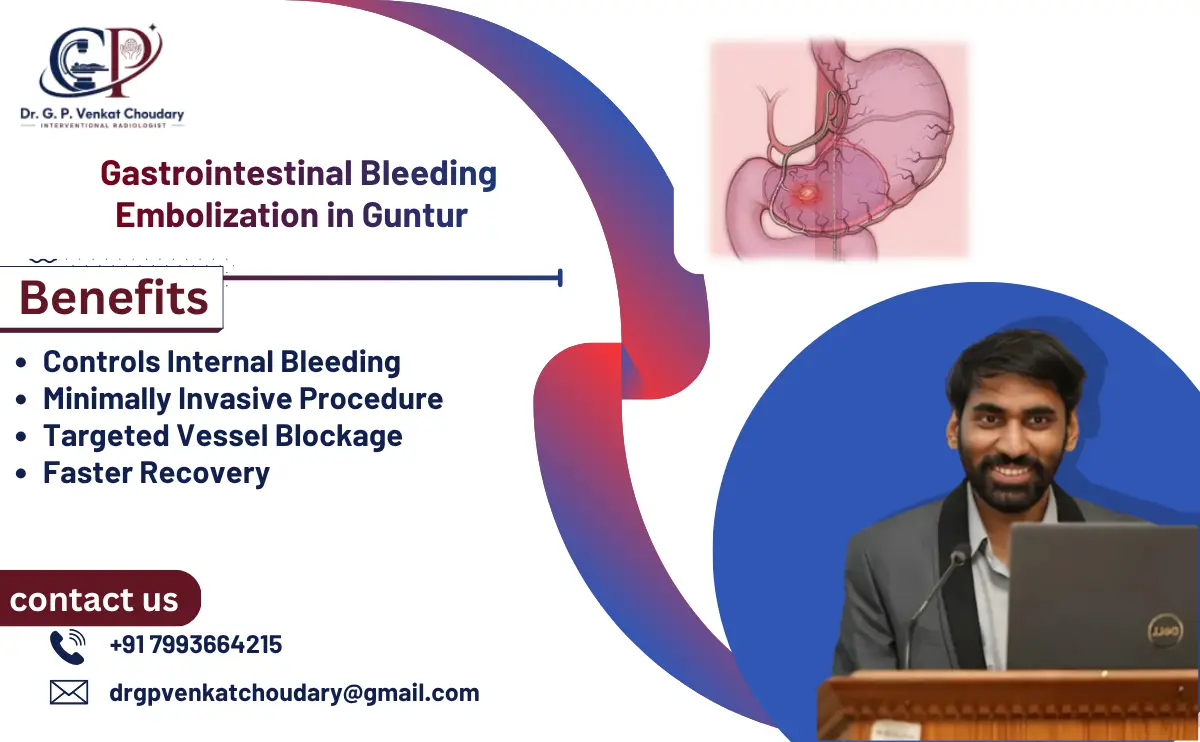
Gastrointestinal (GI) bleeding refers to bleeding that originates anywhere in the digestive tract, from the esophagus and stomach to the small intestine, colon, or rectum. Depending on its severity and source, GI bleeding can range from mild blood loss to a medical emergency requiring urgent treatment.
Gastrointestinal Bleeding Embolization in Guntur is a minimally invasive, image-guided procedure that may be used to control active bleeding from a specific blood vessel. It is performed by an interventional radiologist and can be considered when the bleeding vessel can be identified and treated through an endovascular approach.
Dr. G.P. Venkat Choudary is a Neuro & Vascular Interventional Radiologist in Guntur with expertise in image-guided vascular procedures. His interventional services include vascular interventions, stroke thrombectomy, embolization procedures, transarterial chemoembolization (TACE), transarterial radioembolization (TARE), and image-guided tumor ablation procedures.
Symptoms and Causes of Gastrointestinal Bleeding
Recognizing GI bleeding early is important because significant blood loss can affect blood pressure, heart rate, and oxygen delivery to the body’s tissues.
Common Symptoms
Symptoms depend on the location and amount of bleeding. They may include:
- Bright-red blood in the stool
- Black, tarry stools
- Vomiting blood
- Vomiting material that resembles coffee grounds
- Dizziness or light-headedness
- Weakness or unusual tiredness
- Pale skin
- Shortness of breath
- Rapid heartbeat
- Abdominal discomfort
- Fainting in cases of significant blood loss
Occult bleeding may not be visible but can gradually cause iron-deficiency anemia, fatigue, or weakness.
Common Causes
GI bleeding can result from several conditions, including:
- Peptic ulcers
- Gastritis
- Esophageal or gastric varices
- Diverticular bleeding
- Angiodysplasia
- Gastrointestinal tumors
- Inflammatory bowel disease
- Certain vascular abnormalities
- Post-procedural bleeding
- Trauma or other less common causes
The underlying cause needs to be established before the appropriate treatment is selected.
Diagnosis and Gastrointestinal Bleeding Embolization
Diagnosis begins with assessment of the patient’s symptoms, medical history, vital signs, and laboratory results. The clinical team first determines whether the patient is experiencing significant blood loss and whether urgent stabilization is required.
Diagnostic Evaluation
Depending on the suspected source, investigations may include:
- Complete blood count
- Hemoglobin and hematocrit testing
- Coagulation tests
- Liver and kidney function tests
- Upper gastrointestinal endoscopy
- Colonoscopy
- CT angiography
- Conventional catheter angiography
Endoscopy can often identify and treat the bleeding source. When bleeding continues or the responsible vessel can be identified through vascular imaging, interventional radiology may provide another treatment option.
What Is Gastrointestinal Bleeding Embolization?
Gastrointestinal Bleeding Embolization is an endovascular procedure used to block or reduce blood flow through a bleeding vessel.
During the procedure, the interventional radiologist generally:
- Accesses a blood vessel, commonly through the groin or wrist.
- Guides a thin catheter through the arterial system using fluoroscopic imaging.
- Navigates the catheter toward the blood vessels supplying the suspected bleeding site.
- Performs angiography to identify active bleeding or an abnormal vessel.
- Delivers an appropriate embolic material through the catheter.
- Confirms that blood flow to the bleeding vessel has been adequately reduced or stopped.
- Removes the catheter and manages the access site.
The exact technique and embolic material depend on the bleeding location, blood-vessel anatomy, underlying disease, and clinical circumstances.
When Is Embolization Considered?
Gastrointestinal Bleeding Embolization in Guntur may be considered in selected patients when:
- Active arterial bleeding is identified
- Endoscopic treatment has failed or is not feasible
- Bleeding has returned after initial treatment
- The bleeding site is suitable for an endovascular procedure
- The patient’s clinical condition requires rapid control of hemorrhage
Not every GI bleed requires embolization. Treatment is determined by the source and severity of bleeding, the patient’s overall condition, and the findings of diagnostic investigations.
Benefits, Recovery and Treatment Comparison
The principal objective of embolization is to control bleeding while avoiding open surgery when an endovascular approach is appropriate.
Potential Benefits
Depending on the clinical situation, potential benefits of Gastrointestinal Bleeding Embolization in Guntur may include:
- Minimally invasive treatment
- Targeted treatment of the bleeding vessel
- No large surgical incision
- Potentially shorter recovery compared with major open surgery
- Ability to treat selected patients who may not be suitable for surgery
- Treatment of bleeding that persists despite other interventions
As with any medical procedure, embolization has potential risks. These may include bleeding or bruising at the catheter access site, contrast-related complications, non-target embolization, vessel injury, infection, or reduced blood supply to nearby tissue. The specific risks depend on the location and complexity of the procedure.
Recovery After Embolization
Recovery depends on the severity of the original bleeding, the underlying cause, and the complexity of the procedure.
Patients may be monitored after treatment for:
- Recurrent bleeding
- Blood pressure and heart rate
- Hemoglobin levels
- Catheter access-site complications
- Abdominal symptoms
- Kidney function when contrast has been used
Some patients may require continued hospitalization because the original GI bleeding may have caused substantial blood loss or because treatment of the underlying condition is still required.
Following discharge, patients should follow their treating team’s instructions regarding medication, physical activity, wound care, and follow-up appointments.
Embolization vs Endoscopic and Surgical Treatment
The appropriate treatment depends on the bleeding source and clinical circumstances.
Endoscopic treatment can directly identify and treat many upper and lower GI bleeding sources and is commonly used when the source is accessible.
Embolization approaches the bleeding vessel from within the vascular system and may be useful when active arterial bleeding is identified or when endoscopic treatment has failed or is not possible.
Surgery may be required when bleeding cannot be controlled through less invasive approaches, when there is an underlying condition requiring surgical treatment, or when the clinical situation warrants an operation.
These approaches are not necessarily competing treatments. In complex cases, gastroenterologists, interventional radiologists, surgeons, and other specialists may work together.
Dr. G.P. Venkat Choudary and Interventional Radiology Services
Dr. G.P. Venkat Choudary is a Neuro & Vascular Interventional Radiologist in Guntur. His clinical practice includes minimally invasive image-guided procedures for selected vascular and other conditions.
His areas of interventional expertise include:
- Gastrointestinal bleeding embolization
- Vascular embolization procedures
- Stroke thrombectomy
- Neurovascular interventions
- Peripheral vascular interventions
- Transarterial chemoembolization (TACE)
- Transarterial radioembolization (TARE)
- Liver tumor interventions
- Image-guided tumor ablation
- Selected vascular and interventional procedures
For patients with suspected GI bleeding, the appropriate treatment depends on the source and severity of hemorrhage. A specialist evaluation is therefore important before deciding whether an embolization procedure is appropriate.
Frequently Asked Questions
1. What is gastrointestinal bleeding embolization?
Gastrointestinal bleeding embolization is a minimally invasive procedure that uses a catheter to deliver an embolic material to a bleeding blood vessel, reducing or stopping blood flow to the bleeding site.
2. When is GI bleeding embolization needed?
It may be considered when active arterial bleeding is identified and endoscopic treatment has failed, is not feasible, or when embolization is otherwise considered appropriate based on the patient’s condition and vascular anatomy.
3. Is gastrointestinal bleeding an emergency?
Significant GI bleeding can be a medical emergency. Vomiting blood, passing large amounts of blood, black stools accompanied by weakness or dizziness, fainting, or signs of shock require urgent medical assessment.
4. How is the source of GI bleeding identified?
Doctors may use blood tests, endoscopy, colonoscopy, CT angiography, and catheter angiography depending on the suspected bleeding location and clinical situation.
5. Is embolization a surgical procedure?
No. Embolization is an endovascular, minimally invasive procedure performed through a blood vessel using catheter-based imaging guidance rather than a large surgical incision.
6. How long does gastrointestinal bleeding embolization take?
Procedure time varies according to the bleeding location, vascular anatomy, and complexity of the case. The interventional radiologist can provide an individualized estimate after reviewing the patient’s imaging and clinical condition.
7. What happens after embolization?
Patients are monitored for recurrent bleeding, changes in vital signs, blood counts, and possible access-site or procedure-related complications. Additional treatment may be required for the underlying cause of the bleeding.
8. Can embolization replace surgery?
In selected cases, embolization may control bleeding without surgery. However, surgery can still be necessary when embolization is unsuccessful, unsuitable, or when the underlying condition requires surgical management.
9. Is gastrointestinal bleeding embolization suitable for everyone?
No. Suitability depends on the bleeding source, blood-vessel anatomy, severity of bleeding, medical history, and findings from diagnostic investigations.
10. Who performs gastrointestinal bleeding embolization?
The procedure is performed by an interventional radiologist trained in catheter-based, image-guided vascular procedures. Dr. G.P. Venkat Choudary provides interventional radiology services in Guntur.
Conclusion
Gastrointestinal bleeding can have many causes and may range from a minor episode to a potentially serious medical emergency. Rapid diagnosis is important when bleeding is significant or persistent.
Gastrointestinal Bleeding Embolization in Guntur provides a minimally invasive, targeted approach for selected patients with active arterial GI bleeding. It can be considered when endoscopic treatment is unsuccessful or unsuitable and when imaging identifies a treatable bleeding vessel.
Dr. G.P. Venkat Choudary, Neuro & Vascular Interventional Radiologist in Guntur, provides image-guided vascular and interventional procedures, including embolization, stroke thrombectomy, TACE, TARE, tumor ablation, and other selected interventions.
If you or a family member has been diagnosed with gastrointestinal bleeding and embolization has been recommended, book an appointment with Dr. G.P. Venkat Choudary to discuss the diagnosis, available treatment options, and whether an image-guided intervention is appropriate.