


Ischemic vs Hemorrhagic Stroke: Differences, Symptoms and Treatment
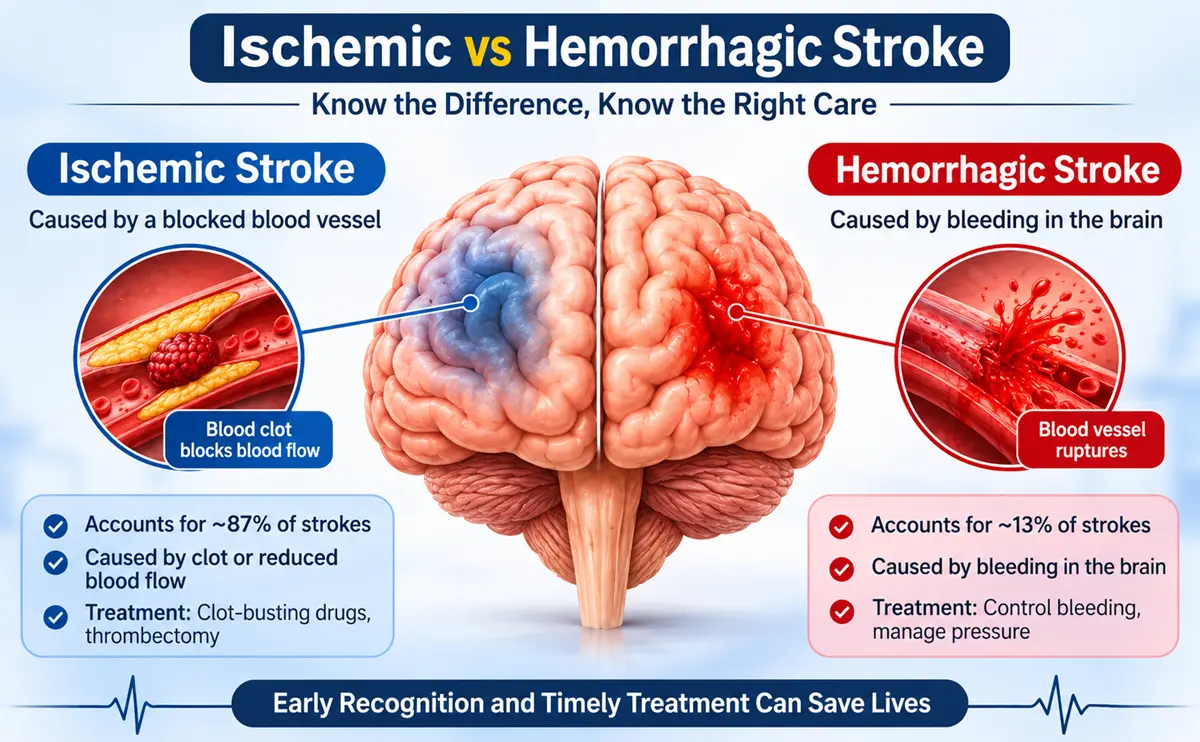
An ischemic stroke happens when a blocked artery cuts off blood to part of the brain. A hemorrhagic stroke happens when a blood vessel bursts and bleeds into or around the brain. The warning signs look alike, but the treatments are opposite, so only a brain scan can show which type it is. Both are emergencies: call 108 or 112 at once.
Families often hear the words ischemic and hemorrhagic in the emergency room without anyone explaining them. This guide explains the two types of stroke in plain language, why doctors scan the brain before treating, and how care differs. It is general information and does not replace emergency care.
Ischemic vs Hemorrhagic Stroke at a Glance
| Feature | Ischemic stroke | Hemorrhagic stroke |
| What happens | A clot or narrowing blocks an artery | A vessel bursts and bleeds |
| Share of strokes | Larger share, roughly 7 in 10 worldwide | Smaller share, roughly 3 in 10 worldwide |
| Common causes | Narrowed arteries, clots from the heart, small-vessel disease | Long-standing high blood pressure, aneurysm, AVM, blood thinners |
| Typical onset | Sudden weakness, speech or vision loss | Sudden severe headache, vomiting, drowsiness, often with weakness |
| First test | CT scan, usually with CT angiography | CT scan, where bleeding shows within minutes |
| Main treatment | Clot-dissolving medicine, clot removal (thrombectomy) | Blood pressure control, stopping the bleed, sometimes surgery or catheter treatment |
| Why the scan matters | Clot-dissolving medicine can help | The same medicine could make bleeding worse |
What Is an Ischemic Stroke?
An ischemic stroke occurs when an artery that supplies the brain is blocked. The blockage may be a clot that formed in a narrowed artery, or a clot that travelled from the heart or neck. Long-standing high blood pressure and diabetes can also damage the smallest brain vessels. Starved of blood, the affected brain tissue starts to die within minutes. A blockage that clears by itself is called a TIA, or mini-stroke, and is a warning that a full stroke may follow.
What Is a Hemorrhagic Stroke?
A hemorrhagic stroke (also spelled haemorrhagic) is bleeding in or around the brain. There are two main kinds:
- Intracerebral hemorrhage (ICH): bleeding inside the brain tissue, most often from small vessels damaged by years of high blood pressure. It is the more common hemorrhagic type.
- Subarachnoid hemorrhage (SAH): bleeding into the space around the brain, usually from a burst aneurysm, which is a weak bulge in an artery wall. It often causes a sudden, severe headache.
Other causes include blood-thinning medicines, head injury and brain AVMs, which are tangles of abnormal vessels. You can read more in our guide to brain AVM symptoms and diagnosis.
How Common Is Each Type?
Worldwide, about seven in ten strokes are ischemic and about three in ten are hemorrhagic. A national registry of 30 Indian hospitals reported about 60% ischemic strokes and about 34% intracerebral hemorrhages. High blood pressure is the most important risk factor for both types.
Are the Symptoms Different?
The warning signs overlap, so nobody can tell the type at home. Remember BE-FAST: Balance, Eyes, Face, Arm, Speech and Time. Clues that point towards bleeding include a sudden severe headache, repeated vomiting, a seizure, neck stiffness and drowsiness, but ischemic strokes can cause some of these too. Do not wait to see which type it is. Note when the symptoms began and call 108 or 112.
How Doctors Tell the Two Types Apart
A CT scan of the brain is usually the first test because it shows bleeding within minutes. If there is no bleed, CT or MR angiography looks for a blocked artery, and perfusion imaging can show how much brain tissue may still be saved. When bleeding is found, a CT angiogram or a cerebral angiogram, a catheter X-ray test, can look for a cause such as an aneurysm or AVM. Blood tests, an ECG and blood pressure checks complete the picture.
Why Treatment Is Opposite
In an ischemic stroke the goal is to reopen the blocked artery. In a hemorrhagic stroke the goal is to stop the bleeding and protect the brain from pressure. Clot-dissolving medicine and blood thinners can help an ischemic stroke but could worsen a bleed, which is why treatment starts only after a scan. This is also why giving medicines at home, or waiting to see if symptoms pass, is unsafe.
Ischemic Stroke Treatment
- Clot-dissolving medicine through a vein (tenecteplase or alteplase): usually within 4.5 hours of onset, and in selected patients with advanced imaging up to about 9 hours.
- Mechanical thrombectomy: a catheter removes a clot from a large brain artery. Current guidelines support it within 6 hours for eligible patients and up to 24 hours in carefully selected ones. Our page on brain stroke treatment in Guntur and our guide to mechanical thrombectomy for stroke explain the steps.
- Prevention medicines: antiplatelet or anticoagulant drugs, and control of blood pressure, cholesterol and diabetes.
The honest pros and cons: fast treatment can save brain tissue, but there are strict time windows, medicines carry a bleeding risk, and thrombectomy suits only some patients and needs a specialised team.
Hemorrhagic Stroke Treatment
Care depends on the type and cause:
- Intracerebral hemorrhage: careful blood pressure lowering, reversing blood thinners where relevant, ICU monitoring and, in selected patients, surgery to relieve pressure.
- Subarachnoid hemorrhage: the burst aneurysm is secured by catheter coiling or surgical clipping.
- AVM bleed: the AVM is treated afterwards with embolization, surgery or radiosurgery, or monitored.
The honest limits: options are narrower than for ischemic stroke, and the 2022 American Heart Association guideline noted that some therapies once thought helpful are less effective than believed. Outcome depends on the size and place of the bleed and how quickly care starts.
Causes and Risk Factors: What Is Shared and What Differs
- Shared: high blood pressure (the most important), diabetes, tobacco, heavy alcohol use and older age.
- More typical of ischemic stroke: narrowed arteries, high cholesterol, atrial fibrillation and other heart disease.
- More typical of hemorrhagic stroke: aneurysm, AVM, blood-thinning medicines, head injury and cerebral amyloid angiopathy in older adults.
Recovery and Preventing Another Stroke
Recovery depends on the area of the brain affected and how early rehabilitation begins. Physiotherapy, occupational therapy and speech therapy help many people regain function. To lower the risk of another stroke, control blood pressure, stop tobacco, manage diabetes and cholesterol, and take prescribed medicines. Anyone with a known aneurysm or AVM should keep follow-up appointments.
When to See a Doctor
Call 108 or 112 immediately for sudden face drooping, arm weakness, speech trouble, vision loss, loss of balance or a sudden severe headache. See a doctor urgently if symptoms appear and then disappear, because that can be a TIA. Also see a doctor if blood pressure stays high or your heartbeat feels irregular.
Frequently Asked Questions
What is the main difference between ischemic and hemorrhagic stroke?
An ischemic stroke is caused by a blocked artery, while a hemorrhagic stroke is caused by a bleeding blood vessel. They are treated in opposite ways, so a brain scan is needed to tell them apart.
Which type of stroke is more dangerous?
Both are emergencies. Hemorrhagic strokes often carry a higher risk of death in the first weeks, but ischemic strokes can also cause severe disability. Outcome depends on the size and place of the stroke and how quickly treatment starts.
Can you tell which stroke it is from the symptoms?
No. The warning signs overlap, and only a CT or MRI scan can show whether the cause is a blockage or a bleed. Call 108 or 112 without waiting to find out.
Can an ischemic stroke turn into a hemorrhagic stroke?
Sometimes bleeding develops inside an area damaged by an ischemic stroke, which is called hemorrhagic transformation. It is more likely after a large stroke or after clot-dissolving treatment, so the team monitors patients closely.
Why can clot-dissolving medicine not be given for a bleeding stroke?
Clot-dissolving medicine breaks down clots, so in a stroke caused by bleeding it could make the bleeding worse. That is why doctors scan the brain before giving it.
Can a hemorrhagic stroke be treated with surgery or a catheter procedure?
Yes, in selected cases. Surgery can relieve pressure from a large bleed, and a burst aneurysm can be secured by coiling or clipping. Many bleeds are managed with blood pressure control and intensive care.
Can both types of stroke be prevented?
Many cases can be prevented or delayed. Controlling blood pressure, diabetes and cholesterol, avoiding tobacco and following prescribed medicines lower the risk of both types.
Where can I get brain stroke treatment in Guntur?
Go to the nearest hospital with emergency care and a CT scan, and call 108 or 112 for an ambulance. Dr. G. P. Venkat Choudary, an interventional radiologist, consults at KIMS-SIKHARA Hospitals, Agatha Varappadu, Guntur.
Talk to a Specialist
If you or a family member needs advice on brain stroke treatment in Guntur, stroke recovery or preventing another stroke, you can book a consultation with Dr. G. P. Venkat Choudary, Consultant Interventional Radiologist at KIMS-SIKHARA Hospitals, Mangalagiri Road, near Best Price, Agatha Varappadu, Guntur, Andhra Pradesh 522001. Call or WhatsApp +91 79936 64215 (Monday to Saturday, 10 AM to 5 PM; not an emergency service). For a stroke happening now, call 108 or 112. Book an Appointment
Medical disclaimer: This article is for general information and does not replace medical advice, diagnosis or treatment. Stroke is a medical emergency, so call 108 or 112 without delay.
References
- Prabhakaran S, et al. 2026 Guideline for the Early Management of Patients With Acute Ischemic Stroke: A Guideline From the American Heart Association/American Stroke Association. Stroke. Published online 26 Jan 2026. doi:10.1161/STR.0000000000000513. Supports: thrombolysis and thrombectomy time windows.
- Greenberg SM, et al. 2022 Guideline for the Management of Patients With Spontaneous Intracerebral Hemorrhage: A Guideline From the American Heart Association/American Stroke Association. Stroke. 2022;53:e282-e361. doi:10.1161/STR.0000000000000407. Supports: ICH management, blood thinner risk, limits of some therapies.
- Hoh BL, et al. 2023 Guideline for the Management of Patients With Aneurysmal Subarachnoid Hemorrhage. Stroke. 2023;54:e314-e370. Supports: aneurysm secured by coiling or clipping.
- National stroke registry of 30 Indian hospitals (2020 to 2022), as reported by South First: https://thesouthfirst.com/health/one-in-seven-stroke-patients-in-india-is-under-45-over-half-die-study/ . Supports: about 60% ischemic and about 34% intracerebral hemorrhage. Primary publication still to be located.
- Global Burden of Disease 2021 stroke estimates, Lancet Neurology 2024. Supports: roughly 7 in 10 ischemic and 3 in 10 hemorrhagic. The figure was seen on a secondary source, so confirm it in the primary paper.
- Koga M. Blood pressure management in stroke: comparative review of recent AHA, ESC, ESH and JSH guidelines. PMC12960239: https://pmc.ncbi.nlm.nih.gov/articles/PMC12960239/ . Supports: hypertension as the main risk factor for both types.
- American Stroke Association. Warning signs of stroke (BE-FAST). Supports: symptom list.
One thought on “Ischemic vs hemorrhagic stroke”